

Researchers, marketers, and developers use Congolese residential proxies to access geo-locked content, monitor local platforms, and gather accurate on-the-ground data.
Buy Republic of the Congo Residential Proxies. Republic of the Congo IPs from $0.27/GB
Access 7.5M+ monthly active residential IPs across 150+ countries, including real device IPs in the Republic of the Congo, starting at $0.79/GB with 99.9% uptime. Collect local pricing data, verify ads, and scrape Congo-based sites without blocks or geo-restrictions.
1 TB free to start. No credit card. Running in 60 seconds.
84,210Republic of the Congo IPs available now
1.2savg response
99.4%success rate 30d
Quick answer
Geonode provides 84,210 residential proxies with Republic of the Congo IP addresses across 12 cities, from $0.79/GB ($0.27/GB at scale) Republic of the Congo proxies let you access Republic of the Congo-only content, local SERP results and region-specific pricing — rotating or sticky, no credit system.
Live Republic of the Congo proxy availability
Real-time pool data by city, updated continuously
| City | IPs Available | Protocol | Latency | Status |
|---|---|---|---|---|
| Brazzaville | 22,400 | HTTP / SOCKS5 | 0.8s | Live |
| Pointe-Noire | 18,700 | HTTP / SOCKS5 | 0.9s | Live |
| Dolisie | 5,300 | HTTP / SOCKS5 | 1.1s | Live |
| Nkayi | 3,100 | HTTP / SOCKS5 | 1.3s | Live |
| Impfondo | 1,800 | HTTP / SOCKS5 | 1.5s | Live |
Quick answer: what is a Congolese proxy and who needs one
A Congolese proxy routes your traffic through a real IP address assigned inside the Republic of the Congo, making remote servers treat your requests as locally originated.
Free Republic of the Congo proxy list: how our Republic of the Congo IPs are sourced and updated
Our free proxy list is compiled from continuously scanned public nodes across MTN Congo, Airtel Congo, and Congo Télécom networks.
The list refreshes every 10–15 minutes, and a live availability check runs automatically, so the displayed proxies reflect current uptime. Typical live rates hover around 40–60%, which means manual validation is still recommended before you rely on any single entry.
- Ping each proxy to confirm round-trip latency is below 800 ms before use.
- Run an IP geolocation lookup to verify the exit node resolves inside the country.
- Test against a known local URL such as Adiac-Congo.com to confirm geo-unlocking works.
- Check the anonymity level to ensure your real IP address is fully masked during the session.
Republic of the Congo proxy types: residential, ISP, datacenter and mobile
Choosing the right proxy type depends on your target site's bot-detection sophistication, the speed you need, and your budget.
The four main categories each offer distinct trade-offs.
Residential
Residential proxies use IPs assigned by real ISPs to real households. They carry the highest trust score with target servers, making them ideal for scraping protected portals and accessing geo-restricted streaming catalogues.
ISP
ISP proxies combine datacenter speed with genuine ISP registration. They deliver lower latency than pure residential proxies while still appearing as legitimate consumer connections to most detection systems.
Datacenter
Datacenter proxies offer the fastest throughput and lowest cost per request, but their non-residential ASNs are more easily flagged by aggressive anti-bot systems. Best suited for bulk data collection on lightly protected sites.
Mobile
Mobile proxies use IPs tied to 4G/LTE carriers such as MTN Congo and Airtel Congo. Because mobile IP ranges are shared by millions of legitimate users, they receive the most lenient treatment from platform trust algorithms.
- Choose residential when your target enforces strict geo-authentication or fingerprints ASN origin.
- Choose ISP proxies when you need residential-level trust but require consistently low latency.
- Choose datacenter proxies for high-volume, low-risk scraping tasks where speed outweighs stealth.
- Choose mobile proxies when scraping social platforms or mobile-first apps that flag datacenter ranges.
- Combine types using IP rotation to distribute requests and reduce per-IP ban risk.
How to get a Congolese IP address in 4 steps
Getting started with a Congolese proxy takes under five minutes.
Follow these steps to have a working Congolese IP address configured and verified.
- Create a free Geonode account and navigate to the proxy dashboard to select your preferred proxy type and authentication method.
- Filter the endpoint list by location, choose Republic of the Congo, and copy the generated hostname, port, username, and password credentials.
- Paste the credentials into your browser extension, scraping script, or application's proxy settings field and save the configuration.
- Visit an IP geolocation tool to confirm your visible IP resolves to the correct country before starting your actual task.
Republic of the Congo proxy pricing: buy Republic of the Congo proxies from $0.27/GB
Entry-level access to our Congolese residential proxies starts at just $0.27/GB, one of the most competitive rates available for this region.
Volume tiers lower the effective per-GB cost as your monthly usage grows, making large-scale data projects genuinely affordable. Visit our pricing page to model your exact spend based on anticipated traffic.
- Billing is strictly pay-as-you-go, so unused bandwidth never goes to waste at month end.
- All plans include access to the full pool of over 8,000 residential IPs across the country.
- Username/password and IP whitelisting authentication methods are both included at no extra charge.
- 24/7 live support is bundled with every paid tier, covering setup, rotation config, and troubleshooting.
Why target Republic of the Congo specifically
The local internet landscape is still developing rapidly, creating unique data opportunities for businesses entering the Central African market.
Key figures that make a Congolese proxy strategically valuable include the following.
- Approximately 1.1 million people in the Republic of the Congo use the internet as of 2024, representing a 19% penetration rate.
- Online retail revenues remain below $30 million USD in 2024, signalling a ground-floor e-commerce opportunity for early entrants.
- Mobile devices account for over 85% of all internet traffic, making mobile-optimised data collection essential for accurate results.
- The country is served by roughly 4 to 5 major licensed ISPs and mobile operators regulated by ARPCE.
- Facebook maintains over 700,000 registered users engaging in peer-to-peer commerce, dominating the social-commerce space.
- A residential Congolese IP unlocks locally priced mobile-data bundles and Canal+ Afrique catalogues that enforce strict geo-rights.
Top use cases for Republic of the Congo proxies
Ad verification
Confirm that your display campaigns render correctly for local audiences and that ad networks serve the right creatives inside the country.
Price monitoring
Track locally listed prices on regional marketplaces without triggering rate limits or receiving out-of-region pricing responses.
Social media management
Manage multiple Facebook pages targeting the local market while keeping each account anchored to an authentic local IP address.
Streaming access
Access African OTT platforms and Canal+ Afrique catalogues that enforce regional content rights through IP-based geo-authentication.
News and content aggregation
Aggregate editorial content from locally restricted news portals that serve different article versions based on the visitor's detected location.
Market research
Gather search-result data, product listings, and consumer sentiment signals that vary by geography and would be invisible from foreign IP ranges.
- leCongolais.net — scrape local classifieds and community listings for market intelligence.
- Adiac-Congo.com — monitor news coverage and editorial trends in the local media environment.
- Facebook Marketplace — track peer-to-peer pricing and product availability across categories.
- Jumia.com.ci — compare cross-border e-commerce listings to benchmark regional pricing strategies.
- YouTube — verify which video ads and content recommendations surface for users in the country.
Free vs paid Republic of the Congo proxies: what actually works
Free proxies sourced from public lists can technically return a Congolese IP, but their real-world reliability rarely meets production requirements.
Shared bandwidth means speeds degrade unpredictably, and most free nodes rotate off the list within hours of appearing. For occasional manual checks they may suffice; for automated workflows they introduce more failures than they solve.
Paid Congolese residential proxies through Geonode draw from a vetted pool with guaranteed uptime SLAs, dedicated support, and consistent geo-accuracy. The concrete differences worth understanding before choosing are listed below.
- Free proxies offer no uptime guarantee; paid plans maintain SLA-backed availability above 99%.
- Free node speeds fluctuate wildly due to overcrowding; paid proxies deliver stable, metered bandwidth.
- Free IPs are rapidly blocklisted by major platforms; paid residential IPs rotate through clean, unlisted ranges.
- Free lists provide no support channel; paid plans include 24/7 live assistance for configuration issues.
- Free proxies rarely confirm accurate geo-exit; paid nodes are verified to resolve within the target country.
Code quick start: Republic of the Congo proxy in Python, Node.js and cURL
Swap in your Geonode credentials and the proxy endpoint below.
All three examples use username/password authentication and target a Congolese exit node.
# Python (requests)
import requests
proxies = {"http": "http://USER:PASS@proxy.geonode.com:10000",
           "https": "http://USER:PASS@proxy.geonode.com:10000"}
r = requests.get("https://ipinfo.io", proxies=proxies)
print(r.json())
// Node.js (axios + https-proxy-agent)
const axios = require("axios");
const { HttpsProxyAgent } = require("https-proxy-agent");
const agent = new HttpsProxyAgent("http://USER:PASS@proxy.geonode.com:10000");
axios.get("https://ipinfo.io", { httpsAgent: agent }).then(r => console.log(r.data));# cURL
curl -x http://USER:PASS@proxy.geonode.com:10000 https://ipinfo.io- Always use HTTPS tunnelling to prevent credential exposure over unencrypted connections.
- Set a request timeout of at least 15 seconds to accommodate trans-continental routing latency.
- Enable IP rotation at the session level to avoid triggering per-IP rate limits on target sites.
Republic of the Congo proxy FAQ
What is a Congolese proxy used for?
A Congolese proxy assigns your traffic a local IP, enabling geo-restricted content access, local ad verification, price monitoring, and accurate market research inside the country.
Are free Republic of the Congo proxies reliable enough for automated scraping?
Free proxies are generally too unstable for automation. They suffer from rapid blocklisting, unpredictable latency, and no support, making paid residential options far more dependable for production workflows.
How many IPs are in Geonode's Congolese proxy pool?
Geonode maintains over 8,000 residential IPs sourced from real devices connected to local ISPs, giving you a broad and continuously refreshed pool to draw from.
Which ISPs do your Republic of the Congo proxies route through?
The pool spans major local operators including MTN Congo, Airtel Congo, and Congo Télécom, covering the dominant share of the country's broadband and mobile data infrastructure.
Can I use a Congolese proxy to access Canal+ Afrique content?
Yes. Canal+ Afrique and similar African OTT platforms enforce IP-based geo-rights, and a verified residential exit node inside the country satisfies their regional authentication requirements.
How much do Republic of the Congo proxies cost?
Plans start at $0.27/GB. Volume tiers reduce the effective rate for larger projects. Full details are available on the pricing page.
Do I need a proxy to scrape local news sites like Adiac-Congo.com?
Some local portals serve restricted content or different article versions based on visitor location, so a local IP ensures you retrieve the same experience as an in-country reader.
How does Geonode's proxy pool compare with neighbouring countries?
Coverage extends across the region; if your project spans borders, you can also use proxies for neighbouring markets such as those covered by our Gabon proxy and Chad proxy pages.
What authentication methods are supported?
Both username/password authentication and IP whitelisting are supported on all paid plans, so you can integrate the proxy into any tool or codebase without additional configuration overhead.
Is it legal to use a proxy in the Republic of the Congo?
Using a proxy for legitimate research, ad verification, and content access is lawful. Always comply with a target platform's terms of service and applicable local regulations when deploying proxies.
Start using Republic of the Congo proxies today
Ready to get a verified Congolese IP address?
Access over 8,000 residential IPs from $0.27/GB with no commitment required. Visit our pricing page, choose a plan, and start collecting accurate local data within minutes.
Your privacy is our priority
Grow securely & confidently
Enterprise-grade security and compliance for your data operations
Ethically sourced IPs
Sourced via our in-house Repocket and Zenshield — fully compliant
Customer support
Real humans, fast response, whenever you need help
What Republic of the Congo proxies are used for
Republic of the Congo e-commerce data
Scrape Amazon.de, Otto, Zalando pricing — local IPs see local prices and EUR/DE-specific deals
Localized ad verification
Check how ads render to Republic of the Congo users across Bayern, NRW, Berlin regions
Republic of the Congo SERP tracking
Monitor Google.de rankings from real Republic of the Congo IPs — track .de SERPs vs .com
Geo-restricted content
Access Republic of the Congo-only services (ARD/ZDF Mediathek, RTL+) for testing and research
Republic of the Congo real-estate intel
ImmoScout24, Immowelt listings — properties often gated by IP geography
Local news + price-discovery
Spiegel paywall research, Idealo / Geizhals price-tracking with Republic of the Congo exit IPs
Code Quick Start
Route any request through the Republic of the Congo with these credentials.
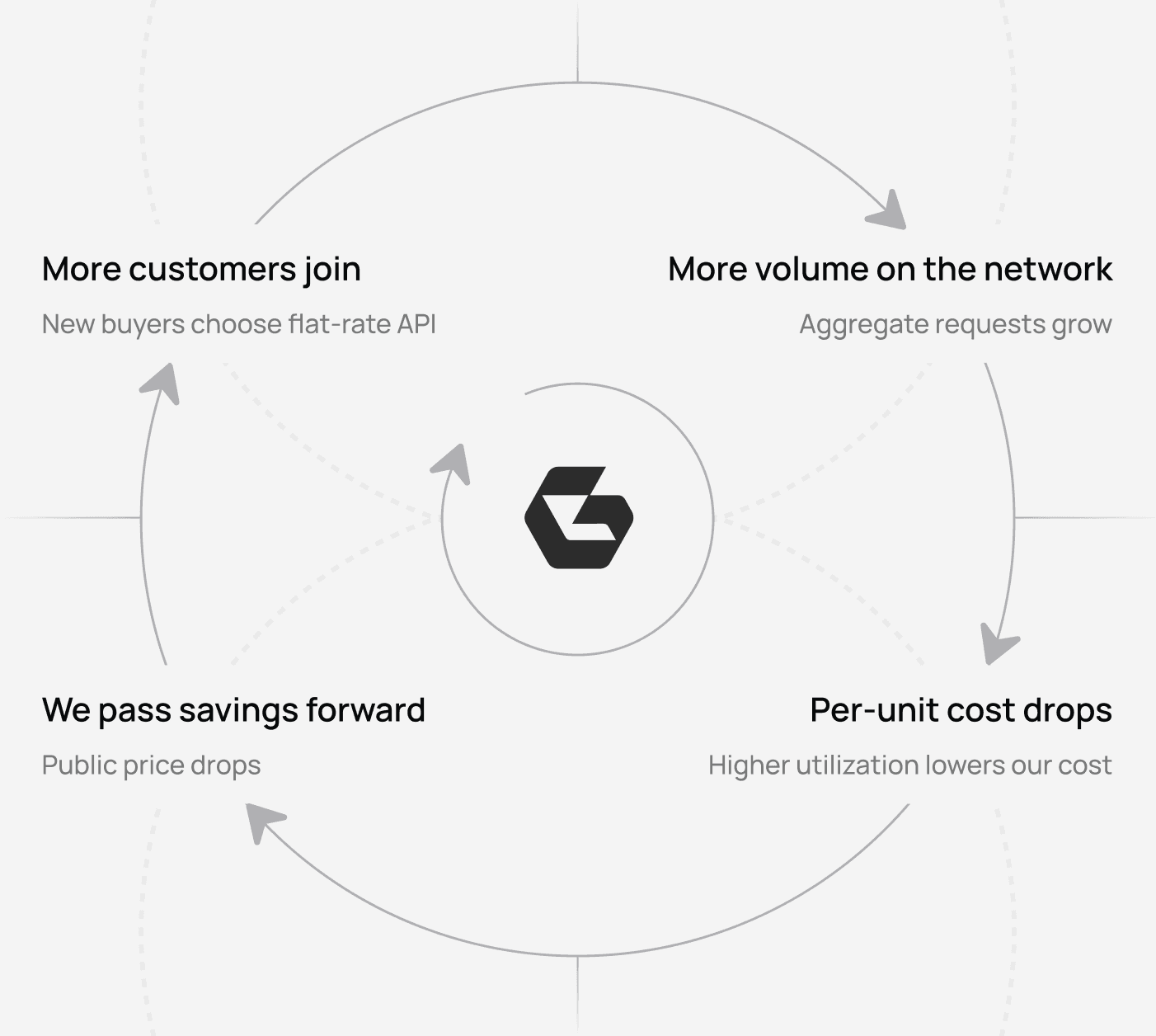
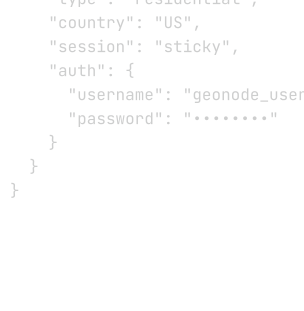
curl -x 203.0.113.10:9000 -U "user:pass" "http://ip-api.com"Here's how we offer low prices on world-class quality
Most scraping APIs run on rented supply with credit-based pricing. That's why your bill is unpredictable. We chose the opposite path and the math compounds.
Legal use of proxies in Republic of the Congo
Using residential proxies may be lawful for legitimate purposes, including market research, ad verification, SEO monitoring, fraud prevention and competitive intelligence on lawfully accessible public data.
Extraterritorial privacy laws like GDPR and CCPA require that any personal-data collection through proxies comply with applicable privacy and data-protection requirements. Scraping behind authentication walls, circumventing technical access controls, accessing non-public data, or copying protected content may be restricted under unauthorized-access, intellectual-property, database-rights and contract rules — stay on lawfully accessible public endpoints.
Geonode IPs are ethically sourced via opt-in consumer apps, including Repocket and Zenshield, with source-side consent and compliance controls.
Not legal advice — consult local counsel for your jurisdiction and specific use case.
Republic of the Congo proxy FAQ
Sign up for a free Geonode trial, select Republic of the Congo or a specific city in the dashboard or via the API geo-targeting parameter, and route your requests through the endpoint. You'll be running on an IP in Republic of the Congo in under a minute — no credit card required to test.
Add the Geonode endpoint with your credentials and append the country parameter for Republic of the Congo to the proxy username string. It works with any language or tool that supports HTTP/SOCKS5 proxies — Python, Node.js, cURL, or browser automation frameworks like Playwright and Puppeteer.
Yes. Geonode offers a free trial with no credit card required, so you can verify IP quality, speed, and success rates in Republic of the Congo on your real targets before committing. Trial traffic runs on the same residential pool as paid plans.
No. If you can copy an endpoint and a password, you can route traffic through Republic of the Congo. The dashboard generates ready-to-use proxy strings, and browser users can connect through any standard proxy extension without writing code.
Yes. Geonode supports city-level and state/region-level targeting inside Republic of the Congo. Pass the city name in the proxy username string or pick it in the dashboard — city targeting costs nothing extra over country-level targeting.
Yes. All 150+ countries, including Republic of the Congo, are available in every plan at the same price. You can switch locations per request via the geo-targeting parameter — no separate purchase or plan change needed.
For long-lived identity you can hold a sticky session on the same residential IP in Republic of the Congo for up to 30 minutes, and dedicated/ISP options provide longer-term static addresses. For most scraping and testing tasks in Republic of the Congo, rotating IPs with sticky sessions cover the need.
Geonode's IPs in Republic of the Congo are sourced from real devices physically located in the country, so they resolve correctly in major geo-IP databases like MaxMind and IP2Location. If a target site uses a stale database, rotating to the next IP resolves the mismatch.
Yes — using residential proxies is legal in Republic of the Congo and most jurisdictions. Geonode's residential IPs come from consenting device owners who are compensated for sharing bandwidth. What matters legally is how you use them: follow local data-protection laws and the terms of the sites you access.
Generally no. Free proxies in Republic of the Congo are usually overloaded, short-lived, and run by unknown operators who can log or alter your traffic. They're fine for a one-off anonymity check, but for anything involving accounts, payments, or business data, use authenticated proxies from a transparent provider.
From real residential devices in Republic of the Congo whose owners have opted in and are compensated for sharing bandwidth. Ethical sourcing matters practically, not just legally: consensually sourced IPs have cleaner reputations and lower block rates than IPs harvested through malware or hidden SDKs.
No. Target sites see only the residential IP in Republic of the Congo; your real address stays between you and the proxy gateway. For full anonymity, also disable WebRTC in the browser and avoid logging into accounts that identify you.
Residential proxies for Republic of the Congo start at $0.83/GB on pay-as-you-go, with flat-rate unlimited plans from $60/month. A GB is a GB — no credit multipliers, and failed requests don't count against your traffic. Country and city targeting are included at no extra charge.
Geonode accepts major credit and debit cards, PayPal, and cryptocurrency. Plans are prepaid with no long-term contract — start pay-as-you-go and switch to an unlimited plan whenever your Republic of the Congo traffic grows.
No. Geonode charges the same rate for every location, so Republic of the Congo costs exactly what any other country costs. Some providers add premiums for specific geos — with Geonode, switching locations never changes your bill.
On pay-as-you-go you pay only for traffic used; on unlimited plans (from $60/month) there is no bandwidth cap and no concurrency cap. Heavy scraping jobs targeting Republic of the Congo typically come out far cheaper on flat-rate unlimited than per-GB billing.
Yes. You can hold the same IP in Republic of the Congo for 1–30 minutes — required for login flows, multi-step checkouts, and account management. Session duration is set in the proxy username string or via the API.
Residential IPs in Republic of the Congo run on real consumer connections, so expect typical household speeds plus roughly 100–300 ms of routing latency. For high-throughput jobs, run concurrent sessions — Geonode doesn't cap concurrency on unlimited plans.
Yes, both. HTTP(S) covers most scraping and browser use; SOCKS5 handles non-HTTP traffic like custom TCP tools. Protocol choice doesn't affect pricing or pool access — the same Republic of the Congo pool serves both.
By default every request through the Republic of the Congo endpoint gets a different residential IP from the pool. If you need continuity, switch to a sticky session (1–30 minutes on one IP). Rotation mode is controlled per request, so you can mix both in one project.
Yes — this is one of the most common uses. An IP in Republic of the Congo shows you Google results exactly as local users see them, which is essential for accurate rank tracking, SERP scraping, and ad verification in Republic of the Congo.
Residential IPs in Republic of the Congo belong to real home devices, so websites treat them as ordinary local visitors — the safer choice for sites with anti-bot protection. Datacenter IPs are faster and cheaper but easier to detect and block.
Geonode's IPs in Republic of the Congo are genuine residential addresses, so they pass the IP-reputation checks that flag datacenter ranges. Detection then depends on your setup: match headers, fingerprint, and request behavior to a normal local user and block rates stay minimal.
An IP in Republic of the Congo makes sites serve you the local version of their content — local prices, local search results, local availability. Note that streaming platforms prohibit region switching in their terms of service, so use proxies for content access at your own discretion and review the target site's terms.
Proxies in other locations
Same network, same pricing, different exit country. Every location below runs on Geonode's own IP pool with per-GB billing and no credit system.


Start using Republic of the Congo proxies today
84,210 Republic of the Congo IPs. From $0.27/GB. Running in 60 seconds.
